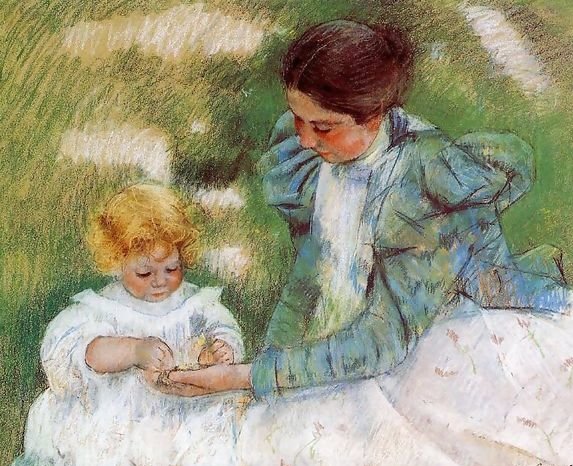
"There's only one thing in life for a woman; it's to be a mother....
A woman artist must be ... capable of making primary sacrifices." Mary
Cassatt was an artist of surprises, mostly small, but often subtle and
profound. Cassatt is known as a "painter of mothers and children." Mary
Cassatt often created images of the social and private lives of women,
with particular emphasis on the intimate bonds between mothers and
children. Mary Cassatt is considered the first American
Impressionist artist, she was born in
Pittsburgh and lived in France. Mary Stevenson Cassatt was born on May
22, 1844 in Allegheny City, Pennsylvania, into a well-to-do family. The
Cassatt family was of French Huguenot origin; they escaped persecutions
and came to New York in 1662. Cassatt grew up in an environment that
viewed travel as integral to education; she spent five years in Europe
and visited many of the capitals, including London, Paris, and Berlin.
Mary Cassatt had her first lessons in drawing and music while abroad and
learned German and French. Mary Cassatt's first exposure to French
artists
Ingres, Delacroix, Corot, and
Courbet was likely at the Paris World's Fair of 1855. Also exhibited at
the exhibition were Degas and Pissarro, both of whom would be future
colleagues and mentors. Mary
Cassatt chose career over marriage, and left the United States in 1865
to travel and study in Europe. The fact that Mary Cassatt had chosen to
seek a vocation at all would have been startling to any well-to-do
parents of a daughter in the early 1860s. Her decision to become a
professional artist must have seemed beyond the pale, given that serious
painting was largely the domain of men in the 19th century. Often
traveling alone, Mary Cassatt studied in Paris, Rome, Parma and Seville,
before returning and settling permanently in the French capital in 1874.
Aided by her elder sister, Lydia, who joined Mary in Europe, she took an
apartment and studio. Lydia was not only her older sister, but also Mary
Cassatt's closest friend and often times her model. There are eleven
known works with Lydia, including "Lydia Crocheting in the Garden at
Marly." The painting, painted in Cassatt's early Impressionist manner,
was posed at Marly-le-Roi, some forty miles west of Paris, where the
artist's family spent the summer of 1880. The painting was included in
the exhibition held by the French Impressionists in Paris in 1881. The
most important influence on Cassatt in the years before 1875 was
exercised by
Edouard Manet. Although he did not
accept students, Mary Cassatt saw his works and they were much discussed
both by painters and art critics. The paintings she produced in this
period, of women flirting, tossing flowers, sharing refreshment with a
bullfighter, reveal a young artist eager to combine the skill of the Old
Masters with the adventuresome subject matter of the moderns. It was
while walking past a Paris gallery window in 1874 that Mary Cassatt
first saw a bold pastel of ballet dancers by
Edgar Degas. That same year, Degas saw
Cassatt's entry in the French Academy Salon. Mary
Cassatt became more and more frustrated with the Salon. Cassatt saw that
works by female artists were often dismissed with contempt unless the
artist had a friend or protector on the jury, and she would not flirt
with jurors to curry favor. In 1877, both her entries were rejected, and
for the first time in seven years Mary Cassatt had no works in the
Salon. At this low point in Cassatt's career she was invited by Edgar
Degas to show her works with the Impressionists, a group that had begun
their own series of independent exhibitions in 1874 with much attendant
notoriety. They already had one female member, artist
Berthe Morisot, who became Cassatt’s
friend and colleague. Mary Cassatt remembers.
“I accepted with joy. Now I could work with absolute independence
without considering the opinion of a jury. I had already recognized who
were my true masters. I admired Manet, Courbet, and Degas. I took leave
of conventional art. I began to live.”
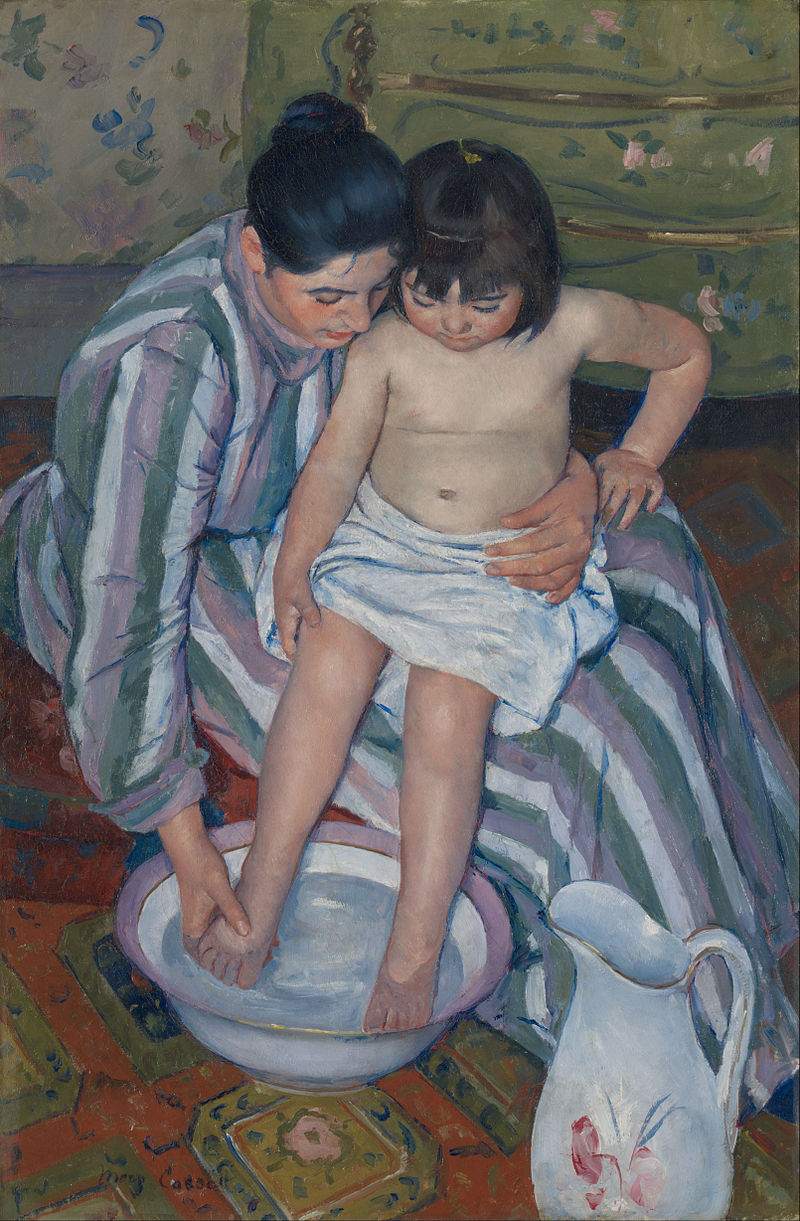
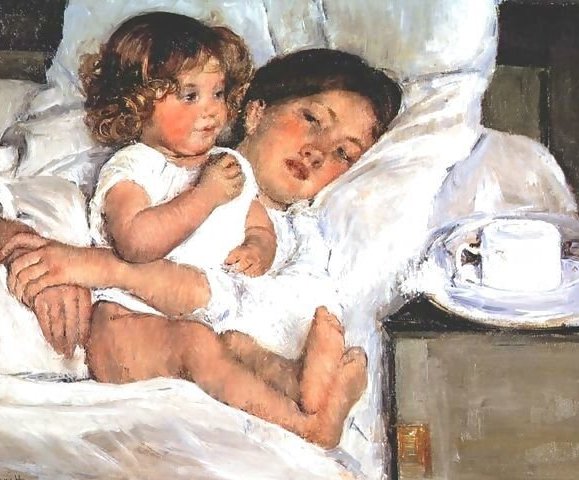
A close friendship with Degas began, which lasted until Degas’ death in 1917. Degas and Renoir greatly influenced Mary Cassatt's style of painting. For a long time Cassatt was even thought of as a pupil of Degas, though their relations were those of two friends, and the influence was mutual. Once, on seeing some of Mary Cassatt’s work, Degas said that he would not have admitted that a woman could draw so well. In 1877, Mary Cassatt was joined in Paris by her father and mother, who returned with her sister Lydia. Mary valued their companionship, as neither she nor Lydia had married. The two decades around the turn of the century proved to be a highly successful and productive period for Cassatt. She focused almost exclusively on the depiction of mothers and children, such as La Toilette . These works today are Mary Cassatt's best-known and most popular paintings. Mary Cassatt's popular reputation is based on an extensive series of rigorously drawn, tenderly observed, yet largely unsentimental paintings and prints on the theme of the mother and child. Almost all of Cassatt’s mother and child scenes do not depict actual mothers with their own children, since the artist preferred to select his models and match the appropriate physical types in order to achieve the desired results. In 1891 Mary Cassatt exhibited a series of highly original colored drypoint and aquatint prints, including Woman Bathing and The Coiffure, inspired by the Japanese masters shown in Paris the year before. Cassatt was attracted to the simplicity and clarity of Japanese design, and the skillful use of blocks of color. In her interpretation, Mary Cassatt used primarily light, delicate pastel colors and avoided black, a “forbidden” color among the Impressionists. "I have touched with a sense of art some people – they felt the love and the life. Can you offer me anything to compare to that joy for an artist"? |