| View Cart
|
|
| Browse Simply Art using the java menu above, search using our custom search box, or click here to use our indexed sitemap! |
|
Simply Art Styles: Fauvism For the Fauves, it really was all about the color! The word Fauvism comes from the French word 'fauve' which means 'wild
animals’ and indeed this new modern art style was thought a bit wild
with its strong vivid colors. The name, Les Fauves was actually first
used as a derogatory remark about their work by French art critic Louis Vauxcelles. It referred to Matisse and the others’ choice of colors,
indicating that their work was savage and primitive. Fauvism was a brief
art movement made up of several young Parisian painters at the beginning
of the 20th century. Primarily a transitional movement, Fauvism came
about as the art world shifted from the
Post-Impressionism of
Vincent Van Gogh,
Paul Cezanne, and
Paul Gauguin to the
Cubism of Georges Braque and
Pablo Picasso. Fauvism can be classified as an extreme development
of Van Gogh's Post-Impressionism fused with the pointillism of Seurat
and other Neo-Impressionist painters, in particular
Paul Signac. The Fauvists' painters never formed a
movement in the strict sense of the word, but for years they would nurse
a shared ambition, before each went his separate and more personal way.At the end of the nineteenth century, neo Impressionist painters were already using pure colors, but they applied those colors to their canvases in small strokes. The fauves rejected the impressionist palette of soft, shimmering tones in favor of radical new style, full of violent color and bold distortions. The Fauve painters were in favor of applying bold untouched colors to their canvases in broad rough strokes that on many occasions would distort their subject. The principles of Fauvism permitted the artists the freedom to think outside of the traditional academic structure, and by allowing the artists the luxury of free thinking they were able to create paintings of interpretations instead of an imitation of the actual subject matter. Henri
Matisse was the founding father of Fauvism. Matisse is regarded as one
of the great formative figures in 20th-century art, a master of the use
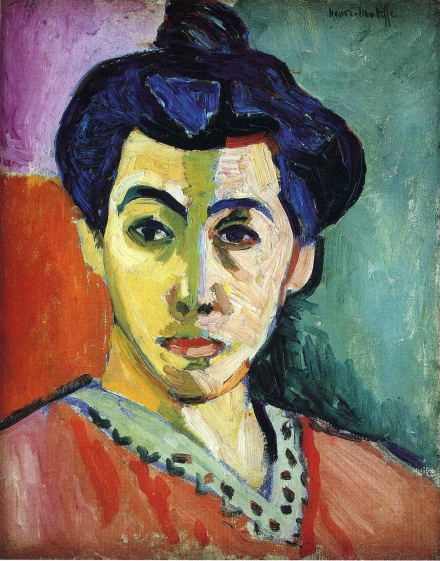
of color and form to convey emotional expression. Other artists of the movement included Andre Derain, Raoul Dufy, Maurice de Vlaminck (his painting "The Circus" is shown above), and Georges Rouault. The fauves did not attempt to express political statements, ethical opinions, or philosophical or psychological ideas in their paintings. Instead they painted subjects that invoked feelings of pleasure, joy and comfort. The fauves favored intense color and vigorous brush strokes and would never consider painting objects in their natural colors. The most famous painting from the Fauvism movement, is probably Matisse’s Green Stripe (shown here). In this portrait of his wife, Matisse used solid colors throughout, and depended entirely upon the intensity of his colors to create depth and shape. Thick black lines and rough brush strokes completed the image. Although it isn’t necessarily a flattering portrait, Matisse did exactly what he intended to, creating a stylistic and primitive painting that deliberately celebrated the use of color. Even though Matisse and many of his followers had been toying with Fauvism since early 1896 it did not become an officially accepted art movement until the Autumn Salon Exhibition in 1905 where fauvists gathered to exhibit their newest works. Our Genuine motocross gear online from motorcycle gear online to draped leather jacket is effective for both work and play. You can buy large variety of leather hot pants and quilted kids leather coats at our online Superstore. |
|||
|
| Privacy Disclosure | Advertise with Simply Art | website created by Website Creations |
Be sure and check out some of our other websites like Floridian Nature, California Nature, and Alaskan Nature 1 2 3 4 5 6 7 8 9 10 11 12 12 1 1 1l 1t 1 R R I P S E F D C F B R D S A P O Mi P P Ct A N A R S P S S W Bl M F G M D Sh L T B T Sr S T T St P M Bh Gh Ss Ki Me G E Af T L Da F F Ct Ct Pu Ps Rs T J Py Rrr G Ts Mr L A Ts Ss J A S L C B B N R E T E J E B M Ji B B M Os A U F S A As A A C D F F I M O R O Cs A B B B B B Bi B B Bh B Bd B B Bl Br C ra C C C C Cl C C Cu D D D Ds Dl O Oz D El Mt M R J Pi E L P A F W E J J W F T P G W G T L R R E H P M J C Bt A E P G P C J F R R P N H P Ar E G C W P A F V T T Jl J P F Vi D D M L M E J J Al C T R J A |
|||